More about The Smart Campus Manifesto
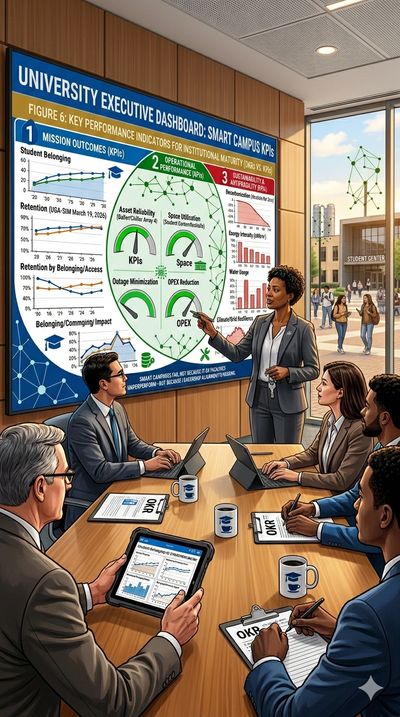
The AI-Enabled Sustainable Smart Campus is more than just technological enhancements; it represents a new institutional operating framework that integrates digital infrastructure, physical systems, and data governance into a unified, adaptable ecosystem. This model fundamentally changes buildings, utilities, and services into components that can be measured and managed, shifting from reactive to predictive approaches. A smart campus strategy combines four essential dimensions:
Technology: It advances from isolated and obscure operational systems to achieve radical interoperability. By utilizing open standards, a unified integration platform, and improved cybersecurity, it links physical assets such as classrooms, labs, vehicles, lighting, boilers, and chillers directly into the institution's digital nervous system.
Operations: It shifts facilities management from a reactive "break-fix" approach to predictive maintenance based on data. IoT telemetry enables AI to evaluate real-time signals—such as pump vibrations—to forecast failures weeks in advance, preventing costly outages and extending asset lifespan. Additionally, it offers new service delivery methods by improving business processes and eliminating repetitive tasks, thereby creating a responsive, frictionless environment.
Governance: It establishes the necessary institutional oversight for the smart campus initiative. This guarantees clear priorities, an essential fiscal commitment, appropriate policies, and precise assessments that align with institutional strategies and span the institution's entire scope.
People: The true value of the smart campus is rooted in human experience. It emphasizes the importance of strong leadership in bridging cultural differences across Technology and Facilities, Academics, Research, and Auxiliary services. The system enables individuals to utilize smart technologies and AI to improve campus operations and create enriching "smart" experiences in learning, teaching, research, and daily campus life.
The Smart Campus Manifesto examines aspects of these and related issues to guide campus leaders through visioning, planning, organizing, implementing, and assessing transformational initiatives for the Antifragile, AI-Enabled Sustainable Smart Campuses

Part I: Introduction
- Executive Summary: A high-level call to leadership, explaining why universities must converge IT and OT to shape a more sustainable, resilient, and intelligent society.
- The Age of Operational Technology and the Rise of the Sentient Campus: Defines the emergence of "Intelligent OT," where buildings become data-generating nodes that sense, learn, and respond.
Part II: The Technology Leader’s Point of View
- Chapter 1: The CTO’s Vision for the AI-Enabled Sustainable Smart Campus: Outlines why modern CTOs must evolve from digital service providers into the "Integrative Architects" of the institution’s cyber-physical future.
- Chapter 2: The Chief Technology Officer’s Strategy: Details the five strategic pillars—Technical Governance, Securing IT/OT, Data Estate, AI/Digital Twin development, and Change Enablement—that drive operational excellence and sustainability.
- Chapter 3: IT Architecture for OT: A technical deep dive into the seven-layer architecture—from signal capture at the edge to the digital twin experience layer—that transforms raw telemetry into trusted institutional intelligence.
Part III: The Facilities Leader’s Point of View
- Chapter 4: The Chief Facilities Officer’s Vision: Redefines the CFO as the "Architect of the Built Environment," moving beyond managing the decline of physical assets to orchestrating a proactive "Cognitive Organism".
- Chapter 5: The Chief Facilities Officer’s Strategy: Focuses on dynamic master planning and data-driven operations to stabilize systems and enhance occupant wellbeing.
- Chapter 6: Sustainability of the AI-Enabled Smart Campus: Frames sustainability as the "Ecological Operating System," where AI-assisted operations optimize energy, water, and waste.
- Chapter 7: The CFO’s OT Architecture: Outlines how facilities success is measured in a smart campus, focusing on architectural aims and execution points.

Part IV: Planning, Organizing, and Leading
- Chapter 8: Unified Smart Campus Leadership: Explains how to bridge the culture gap between IT and Facilities to co-create a shared vision and a "Declaration of Interdependence".
- Chapter 9: Establishing Smart Campus Governance: Describes the practical mechanisms—such as decision rights and the Smart Campus Steering Committee—that prevent fragmented "pilot sprawl".
- Chapter 10: The Smart Campus Data Estate: Details how to build a "Unified Namespace" that organizes all campus data (spatial, static, and live) into a machine-readable directory for AI.
- Chapter 11: The Smart Campus Technology Stack and Digital Architecture: Outlines the hierarchical technology layers required for secure, composable, and scalable campus intelligence.
- Chapter 12: Human and Cultural Factors: A field guide for cultural transformation, addressing how to manage the politics of space, territory, and control.
- Chapter 13: Academic and Research Alignment: Discusses how to turn the physical campus into a "Living Laboratory" that supports faculty innovation and student learning.

Part V: Executing Vision, Strategy, and Plans
- Chapter 14: Smart Campus Implementation: Presents a five-phase roadmap—from Governance and Discovery to Scaling and Continuous Optimization.
- Chapter 15: Current State Inventory and Readiness Assessment: Explains why establishing "operational truth" through a comprehensive asset audit is a prerequisite for modernization.
- Chapter 16: Implementing Change Management: Uses the ADKAR framework to ensure the human workforce is mentally and structurally prepared for the transition to AI-driven workflows.
- Chapter 17: Smart Campus Risks: Identifies unique risk domains—from "Shadow IoT" to ethical AI concerns—and how to engineer antifragility to mitigate them.
- Chapter 18: Measuring Progress: Balances the "Engine" (KPIs) with the "Compass" (OKRs) to track institutional maturity.
- Chapter 19: Application Use Case Patterns: Provides reusable blueprints for smart classrooms, residence halls, central plants, and research labs.
- Chapter 20: Implementing the Campus Digital Twin: Explores the evolution from descriptive to autonomous digital twins, where systems eventually interpret data and make independent decisions.
- Chapter 21: Bringing It All Together: A summary and concluding call for universities to use their convening influence to lead on ethics, climate science, education, and social progress through smart campus transformation.